


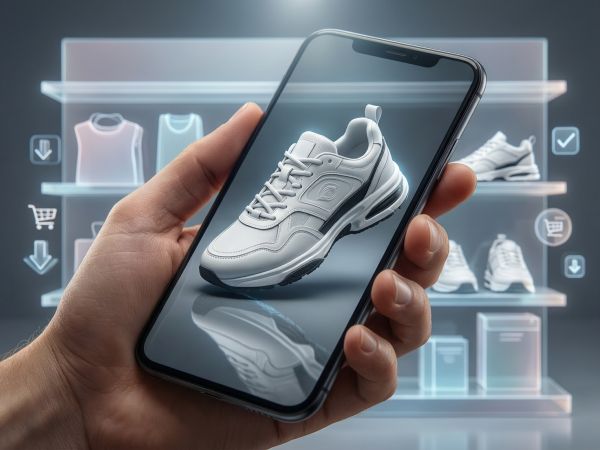
Imagine online customers being able to rotate and inspect products from every angle, as if they were holding them in their hands. This trend is real: global companies are now transforming traditional photo-based catalogs into interactive 3D models powered by AI. This new approach addresses one of the biggest challenges in online shopping—visual uncertainty. 3D catalogs allow customers to examine textures, dimensions, and product functions in greater detail, significantly increasing purchase confidence. Industry reports even project that the global 3D rendering market will grow rapidly—from USD 5.36 billion in 2025 to approximately USD 23.78 billion by 2034. This growth is a major reason why leading global brands are adopting the technology to remain competitive.
AI 3D Technology in Product Catalogs
AI-powered 3D technology enables far more advanced catalog content. Instead of static images, companies now use 3D product visualization, a technique that converts two-dimensional images into accurate three-dimensional representations. With generative AI, this process has become significantly faster and more cost-effective. Today, product photos taken from multiple angles can be transformed into interactive 3D models within minutes—whereas previously, it required specialized experts and weeks of manual work.
There are several primary methods used in AI 3D modeling:
- Photo to 3D
AI photogrammetry combines multiple product photos from different angles to create detailed 3D models. - Text to 3D
AI algorithms generate 3D models from textual descriptions (for example, “a gray office chair”). This approach is rapidly evolving, particularly for product planning and early-stage design. - Video to 3D
Product videos are analyzed to capture complex shapes and movements, making this method suitable for large items such as furniture or sports equipment.
Immersive Customer Experience
3D models dramatically enhance the online shopping experience. With interactive models, customers can rotate, zoom, and inspect products as if they were physically present. For example, shoppers can place a 3D sofa in their living room using AR or virtually “try on” clothing. According to a 2024 study, 91% of users reported that interactive 3D visualization significantly improved their shopping experience, while 52% stated they better understood how a product would look or function. These interactions increase emotional engagement and reduce hesitation during online purchases.
Higher Conversion Rates and Cost Savings
Beyond improving user experience, AI-powered 3D models deliver measurable business benefits. Key advantages include:
- Stronger Product Visualization
Interactive 3D models provide customers with a product understanding comparable to in-store shopping. - Increased Consumer Trust
Realistic details build confidence, helping buyers feel more informed and secure before checkout. - Lower Return Rates
Data shows that brands implementing 3D technology and AI-based sizing experience significant reductions in product returns. For instance, one online retailer successfully reduced returns by 45% after introducing more accurate size selection tools. - Reduced Content Production Costs
Digital 3D catalogs eliminate the need for physical photo shoots and multiple product prototypes, significantly lowering visual production costs.
As a result, conversion rates increase. Amazon, for example, reported that customers are twice as likely to purchase after using its 3D/AR “View in 3D” feature, with an average 9% sales increase on listings that include this option. Another example is Gunner Kennels, which achieved a 40% increase in conversion rates after adding 3D models to its product pages. These results illustrate why many companies view AI-powered 3D catalogs as a high-return investment.
Cost Efficiency and Content Production
The shift to 3D content also accelerates and optimizes marketing production workflows. According to NVIDIA, integrating AI into content pipelines enables faster and more efficient creation of advertising and catalog assets. Unilever, for example, reported producing visual materials twice as fast at half the cost compared to traditional methods. Similarly, Nestlé reduced campaign production time and costs by up to 70% using digital twins—virtual replicas of physical products. In contrast, traditional methods require physical locations, equipment, and multiple product samples, all of which are time-consuming and costly. With 3D rendering, companies rely on digital models to generate high-quality visuals without physical waste.
Personalization and Augmented Reality
Global companies are not only improving product visuals but also delivering more personalized shopping experiences. AI uses consumer data—such as body measurements or color preferences—to customize 3D product models. In furniture catalogs, for example, users can change sofa colors or virtually rearrange room layouts. Major fashion brands such as ASOS and Zara have already adopted augmented reality to allow customers to virtually try on clothing before purchasing. This combination of AI and AR makes online shopping more intuitive by merging digital convenience with the familiarity of a physical fitting room.
Sustainability and Environmental Impact
From an environmental perspective, 3D catalogs are significantly more eco-friendly. There is no longer a need to ship multiple prototypes or conduct photo shoots across various locations. A single digital model can be reused and updated without generating material waste or additional emissions. According to Imagine.io, the use of 3D models eliminates much of the waste traditionally associated with physical product photography, aligning with growing consumer expectations for environmentally responsible business practices. As sustainability becomes increasingly important, this efficiency provides added value for global brands committed to greener operations.
Challenges and Limitations
Despite its advantages, adopting AI-powered 3D technology comes with challenges. Companies must make initial investments in hardware, software, and specialized workforce training. Data quality and accuracy are critical—3D models are only as good as the product data used to create them. Poor data can result in unrealistic visualizations that undermine customer trust. Additionally, mid-sized brands may struggle to scale these solutions across thousands of SKUs due to cost and complexity. Organizational culture also plays a role, as some teams or customers may initially resist catalogs without traditional photography. As a result, many companies implement AI 3D solutions gradually, starting with flagship products or high-volume categories.
Global Market Trends and the Future
The evolution of this technology is far from over. Industry projections indicate that the 3D product visualization market will continue to expand as demand grows for high-quality yet cost-efficient content. NVIDIA has stated that AI-driven content workflows can accelerate production by up to 95% compared to traditional methods. From 2025 onward, integration with OpenUSD and collaborative 3D platforms such as Omniverse is expected to unlock new innovations—ranging from millions of personalized ad variations to localized digital twins of products. These trends suggest that any company aiming to compete globally must consider 3D and AI as core components of its marketing and product strategy.
Conclusion
These combined benefits explain why global companies are increasingly shifting toward AI-powered 3D models for their product catalogs. Superior product visualization, immersive customer interaction, and significant time and cost efficiencies make this transition difficult to ignore. Real-world data supports this shift—for example, Amazon reports doubled purchase likelihood with AR/3D features and an average 9% sales increase when customers can view products in three dimensions. As technology continues to advance, investing in AI-driven 3D catalogs is no longer optional but a strategic necessity. In the years ahead, more large and small brands will follow this path, establishing 3D product catalogs as the new global standard for e-commerce.
Data Sources / Footnotes
- Precedence Research – 3D Rendering Market Size Forecast 2025–2034
- NVIDIA Developer Blog – AI-Powered 3D Content Creation & Omniverse
- Amazon Developer Documentation – 3D & AR Shopping Experience Case Studies
- Shopify Plus & UX Research 2024 – Impact of 3D Visualization on Buyer Confidence
- Imagine.io – Sustainable Product Visualization with 3D Models
About the Author