


The debate surrounding AI’s creative limits has reached a fever pitch among the world’s leading researchers. Recent breakthroughs prove that the claim “AI can create 100% original faces” is largely a digital illusion. The cold reality: generative AI systems do not build faces from scratch; instead, they reconstruct facial features from millions of real human images within their training datasets.¹¹ A seminal study by Rosenberg et al. (2024) identifies three fundamental barriers that shatter the myth of AI facial originality: prompt infidelity, demographic disparity, and unavoidable distributional shifts.²⁴
Statistical evidence reveals a haunting truth: AI generative models are trained on datasets that are inherently biased and demographically imbalanced.³⁸ When prompted to create “100 unique faces,” the system merely generates statistical variations of faces that already exist in its training library. Research shows that these “synthetic faces” often fail to achieve balanced demographic diversity, with generation quality varying significantly across different racial and ethnic groups.²⁵ This is not a glitch—it is a mathematical consequence of how AI learns: by mimicking statistical patterns from pre-existing data.
Editor’s Note: AI does not ‘imagine’—it interpolates. Every ‘original’ pixel is a mathematical ghost of a real human being who never gave their consent to be synthesized. The illusion of novelty is merely the result of high-dimensional blending, where the line between creation and sophisticated plagiarism becomes dangerously thin. At AIVisualNews, we believe understanding this limitation is vital for the future of digital identity and intellectual property rights.
The paradox is stark: while popular claims suggest “AI systems can create entirely unique faces that don’t belong to any real person,”²² the reality on the ground is quite the opposite. The deep learning technology driving facial generation works by interpolating and combining features from training sets containing millions of real human faces.²⁹ A 2025 study by Kramer proves that AI cannot truly produce entirely new identities; instead, it creates a “statistical likeness” that often subconsciously replicates specific facial traits from the original dataset.²⁸
A glimmer of hope emerged when researchers at NYU Tandon successfully mitigated facial recognition bias by generating highly diverse and demographically balanced synthetic datasets.¹² However, Rosenberg (2024) warns that even methods specifically designed to reduce bias still exhibit demographic disparities in the quality of the generated faces.²⁵ The fundamental challenge remains: as long as AI is trained on real human data, it is virtually impossible for the machine to “forget” the specific faces that form the foundation of its learning.¹⁶
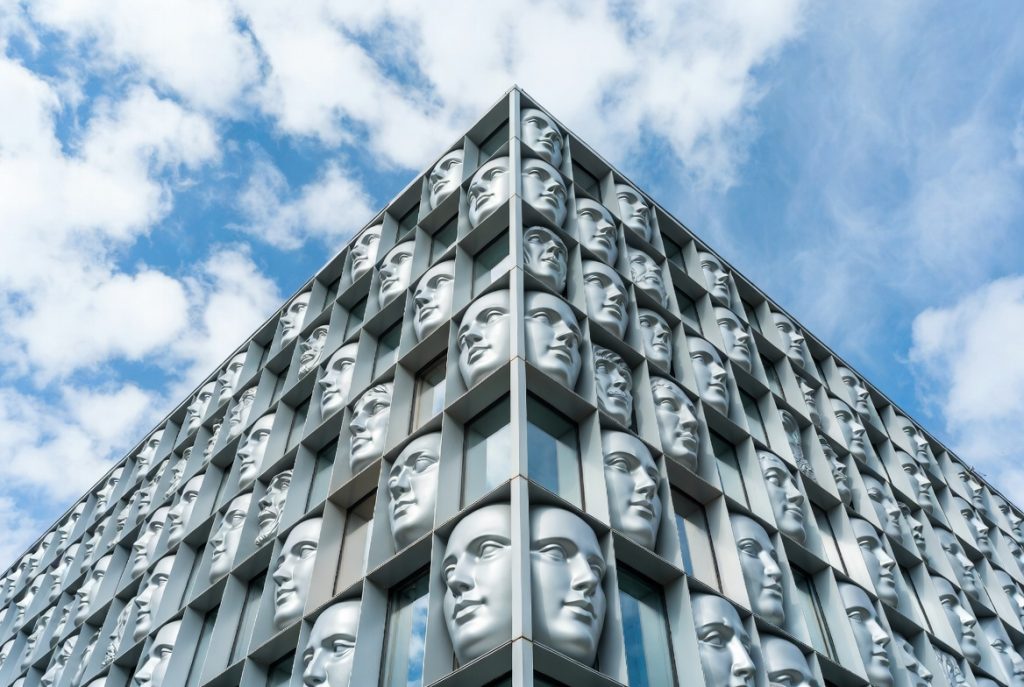
Editor’s Note: True diversity in AI cannot be achieved by simply adding more data; it requires a fundamental redesign of how algorithms perceive human variety. The persistent ‘demographic lag’ in synthetic generation proves that AI is a mirror of our past biases, not a clean slate for our future. We must move beyond the ‘Originality Myth’ and start demanding transparency in the datasets that define our digital likeness.
Shocking predictions from recent studies suggest that the impact of biased tendencies and stereotypical portrayals—which are baked into the training data and perhaps the algorithms themselves—will not be easily erased.²⁹ While AI technology continues to evolve at a breakneck pace, the fundamental constraints of current deep learning architectures make it impossible for AI to create 100 truly original and distinct faces without being haunted by the real human faces that came before.³²
References & Footnotes:
¹¹ Rosenberg, H., et al. (2024). Limitations of Face Image Generation. AAAI Conference on Artificial Intelligence.
¹² NYU Tandon (2024). Researchers mitigate racial bias in facial recognition systems. NYU Tandon School of Engineering.
¹⁶ Messingschlager, T.V. (2025). Algorithmic bias in image-generating artificial intelligence. AI & Society.
²² AI Photo Technology Report (2024). AI Generates Completely Original Faces: Deep Learning Realities. ²⁴ Rosenberg, H., et al. (2024). Limitations of Face Image Generation. arXiv preprint.
²⁵ Rosenberg, H., et al. (2024). Demographic Disparities in Synthetic Generation. University of Wisconsin-Madison.
²⁸ Kramer, R.S.S. (2025). AI-generated images of familiar faces: Indistinguishable from reality. Journal of Experimental Psychology.
²⁹ Messingschlager, T.V. (2025). The impact of biased tendencies and stereotypical portrayals. AI & Society.
³² Rosenberg, H., et al. (2024). Identifying limitations in prompt faithfulness and distribution. AAAI Conference.
³⁸ West, J., et al. (2024). A Case Study of Demographic Disparities in Local ML Systems. ACM Conference Proceedings.
About the Author